close
Choose Your Site
Global
Social Media
Views: 0 Author: Site Editor Publish Time: 2026-04-15 Origin: Site


Understanding the critical differences between seamless steel pipes and welded alternatives can mean the difference between system reliability and costly failures. This comprehensive guide reveals why engineers and procurement managers increasingly specify seamless solutions for demanding applications.
Pressure Performance: Seamless steel pipes handle approximately 20% higher working pressure than welded pipes of identical specifications
Structural Integrity: The absence of weld seams eliminates structural discontinuities, providing uniform strength throughout the pipe body
Corrosion Resistance: Superior performance in corrosive environments due to no heat-affected zones or potential weld contamination
Manufacturing Standards: Compliance with rigorous specifications including ASTM A106, API 5L, and ASME B36.10
Application Range: Ideal for high-pressure hydraulics, oil and gas transmission, chemical processing, and power generation
The selection between seamless steel pipes and welded alternatives represents one of the most critical decisions in industrial piping system design. While both types serve essential roles across various sectors, seamless pipes offer distinct performance advantages that become crucial in high-stakes applications where system failure is not an option.
In the petroleum industry, chemical processing plants, power generation facilities, and high-pressure hydraulic systems, the choice of piping material directly impacts operational safety, long-term reliability, and maintenance costs. Understanding these differences helps engineers and procurement professionals make informed decisions that balance performance requirements with budget constraints.

The most significant advantage of seamless steel pipes lies in their exceptional pressure tolerance. According to ASME code specifications, seamless pipes maintain approximately 20% higher working pressure ratings compared to welded pipes manufactured from identical materials and dimensions.
This performance gap exists because welded pipes contain a longitudinal seam—technically classified as a structural discontinuity. Even with modern high-frequency electric resistance welding (ERW) or submerged arc welding (SAW) techniques, the weld line represents a potential weak point under extreme pressure conditions. Seamless pipes eliminate this concern entirely through their manufacturing process.
For example, an ASTM A312 TP316L seamless pipe with Schedule 80 wall thickness can handle working pressures exceeding 3,000 psi at room temperature. The equivalent welded pipe requires application of a weld efficiency factor of 0.85, effectively reducing its pressure rating by 15% in critical service conditions.
This pressure advantage becomes essential in several industrial scenarios:
High-pressure hydraulic systems operating above 150 bar
Oil and gas transmission pipelines in upstream operations
Steam distribution systems in power generation facilities
Chemical processing plants handling volatile compounds
Downhole drilling equipment subjected to extreme pressures
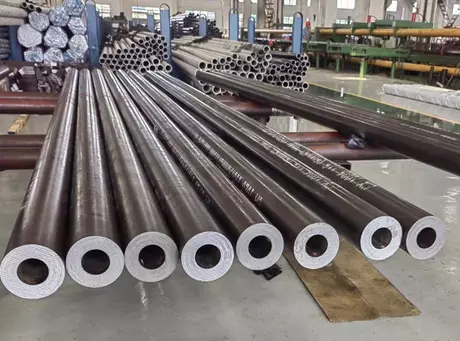
Seamless steel pipes are manufactured from solid steel billets through a hot rolling or cold drawing process. This production method creates a uniform grain structure throughout the entire cross-section of the pipe, resulting in consistent mechanical properties along the entire length.
The cold drawn seamless tube manufacturing process involves heating a solid cylindrical steel billet to approximately 1,200°C, then piercing it with a mandrel to create the initial hollow form. Subsequent rolling and drawing operations refine the dimensions while work-hardening the material. This process ensures that stress distribution remains even under load, with no preferential failure points.
In contrast, welded pipe production begins with flat steel strips or plates that are formed into cylindrical shapes and joined along a seam. Despite advances in welding technology, the heat-affected zone (HAZ) adjacent to the weld experiences microstructural changes that can affect local mechanical properties.
| Performance Factor | Seamless Steel Pipe | Welded Pipe |
|---|---|---|
| Working Pressure Rating | 100% (Full rated capacity) | 80% (0.85 weld efficiency factor) |
| Burst Pressure Tolerance | Up to 20% higher | Standard baseline |
| Cyclic Loading Performance | Excellent (No fatigue concentration) | Good (Weld seam requires monitoring) |
| Temperature Tolerance | Up to 650°C continuous service | Up to 400°C (HAZ concerns above) |
| Stress Distribution | Uniform across entire section | Potential concentration at seam |
When operating in corrosive environments, the absence of a weld seam provides seamless steel pipes with a significant advantage. Corrosion often initiates at points of discontinuity or compositional variation—exactly the characteristics present in welded joints.
Several factors make weld seams more susceptible to corrosion:
Heat-affected zones: The intense heat from welding alters the microstructure of the base metal adjacent to the weld, potentially creating areas with different corrosion potentials
Residual stresses: Welding introduces localized stresses that can accelerate stress corrosion cracking in certain environments
Compositional variations: Slight differences in chemical composition between the weld metal and base metal can create galvanic corrosion cells
Surface irregularities: Even high-quality welds may have minor surface variations that provide sites for localized corrosion initiation
Seamless pipes maintain uniform composition and microstructure throughout their cross-section, eliminating these corrosion-prone features. This becomes particularly critical in applications involving sour gas service (H₂S environments), acidic fluids, or marine atmospheres where corrosion rates accelerate.
CHENGXIN's engineering team has over 15 years of experience specifying seamless steel pipes for critical applications worldwide. Get personalized recommendations based on your pressure, temperature, and corrosion requirements.
Request Technical ConsultationSeamless steel pipes demonstrate exceptional reliability in high-temperature service conditions where welded alternatives may experience performance degradation. Applications requiring continuous operation above 400°C particularly benefit from seamless construction.
In systems subject to frequent temperature fluctuations, such as steam generation systems or thermal oil circuits, thermal cycling creates expansion and contraction stresses. The uniform metallurgical structure of seamless pipes handles these cyclic stresses more predictably than welded pipes, where the weld seam may experience differential expansion rates.
Power generation facilities utilizing supercritical steam conditions (temperatures exceeding 565°C and pressures above 250 bar) exclusively specify seamless pipes manufactured to ASTM A335 specifications. These demanding conditions would quickly exploit any weakness in a welded joint, potentially leading to catastrophic failure.
Industries where system failure carries severe consequences—including offshore oil platforms, nuclear facilities, and aerospace applications—mandate seamless pipe specifications. The inherent safety margin provided by eliminating the weld seam justifies the additional cost in these critical environments.
Major international standards recognize the performance advantages of seamless construction. ASME Boiler and Pressure Vessel Code Section III, which governs nuclear power plant construction, specifically requires seamless pipes for Class 1 nuclear piping systems. Similarly, ASTM A106 seamless carbon steel pipe specifications are mandated for high-temperature service in refinery applications.
The API 5L specification covers both seamless and welded line pipe for petroleum and natural gas industries, but notes that seamless pipes receive preferential specification for sour service conditions and high-consequence areas where pipeline failure could impact populated regions.
While welded pipes require extensive non-destructive testing (NDT) to verify weld integrity—including ultrasonic testing, radiographic examination, and magnetic particle inspection—seamless pipes need less intensive examination. The absence of a weld seam eliminates the primary area requiring detailed inspection, reducing both quality control time and associated costs.
This advantage extends throughout the pipe's service life. Maintenance programs for systems utilizing welded pipe typically include periodic weld seam inspections to detect potential crack initiation or corrosion. Seamless pipe installations reduce these monitoring requirements, lowering long-term operational expenses.
The manufacturing process for seamless steel pipes produces smooth internal and external surfaces free from the irregularities that can occur at weld seams. This surface quality advantage benefits several application types:
Hydraulic circuits require exceptionally smooth internal surfaces to minimize turbulence and pressure loss. Even minor internal discontinuities can create localized turbulence that reduces system efficiency and accelerates component wear. Cold drawn seamless tube manufacturing produces the precise internal finish required for high-performance hydraulic applications.
In heat transfer applications such as boiler tubes and heat exchanger bundles, smooth internal surfaces optimize fluid flow characteristics and heat transfer coefficients. Surface roughness at weld seams can create fouling sites where deposits accumulate, reducing thermal efficiency and requiring more frequent cleaning cycles.
While the initial purchase price of seamless steel pipes typically exceeds welded alternatives by 20-40%, a comprehensive total cost of ownership analysis often favors seamless construction for critical applications. Factors contributing to long-term value include:
| Cost Factor | Seamless Pipe Impact | Long-term Savings |
|---|---|---|
| Inspection Costs | Reduced NDT requirements | 15-25% lower inspection expenses |
| Maintenance Frequency | Lower corrosion rates | Extended service intervals |
| System Downtime | Higher reliability | Reduced unplanned shutdowns |
| Service Life | Typically 20-30% longer | Deferred replacement costs |
| Insurance Premiums | Lower risk profile | Potential premium reductions |
CHENGXIN manufactures premium cold drawn seamless tubes meeting ASTM A106, API 5L, and ASME B36.10 specifications. Our quality management system is ISO 9001:2015 certified with full material traceability and third-party inspection available.
Complete size range from 6mm to 610mm OD
Schedule 5 through XXS wall thickness
Multiple material grades including carbon, alloy, and stainless steel
Fast delivery with global shipping capabilities
Seamless manufacturing processes accommodate a wider range of alloy compositions compared to welding methods. Certain high-alloy stainless steels and nickel-based alloys that are difficult to weld reliably can be produced as seamless pipes with consistent quality.
For applications requiring exotic materials—such as duplex stainless steels (UNS S32205, S32750), super-austenitic grades (UNS N08367), or nickel alloys (UNS N06625, N10276)—seamless production eliminates concerns about weld metal matching, heat input control, and post-weld heat treatment requirements that complicate welded pipe manufacturing.
Understanding when seamless construction becomes essential versus when welded pipe provides adequate performance helps optimize both system reliability and project budgets. Industry best practices suggest the following decision framework:
Operating pressures exceed 100 bar (1,450 psi)
Continuous service temperatures surpass 400°C
Applications involve cyclic loading or pressure fluctuations
Corrosive environments include sour gas, acidic compounds, or chlorides
Regulatory codes mandate seamless construction (ASME Section III, certain API applications)
System failure consequences include safety hazards or environmental damage
Pipe diameters fall within the seamless manufacturing range (typically up to 24 inches)
Low-to-medium pressure applications below 80 bar
Large diameter requirements exceeding 24 inches (610mm)
Cost-sensitive projects where budget constraints are primary
Structural applications where the pipe carries no internal pressure
Non-corrosive service conditions with benign fluids
The advantages of seamless steel pipes over welded alternatives become compelling in applications where pressure tolerance, structural integrity, corrosion resistance, and long-term reliability are critical performance parameters. The absence of a weld seam—eliminating the primary structural discontinuity and potential failure point—provides seamless pipes with inherent advantages that justify their higher initial cost in demanding service conditions.
For industrial applications involving high pressures above 100 bar, elevated temperatures exceeding 400°C, corrosive environments, or where system failure carries significant safety or economic consequences, seamless construction represents the engineering choice that balances performance requirements with long-term value. The uniform grain structure, superior pressure ratings, enhanced corrosion resistance, and reduced inspection requirements combine to deliver lower total cost of ownership despite higher upfront investment.
Modern manufacturing capabilities have narrowed the performance gap for certain welded pipe applications, particularly with advanced welding techniques and rigorous quality control. However, for critical applications where reliability cannot be compromised, seamless steel pipes continue to set the industry standard for performance and dependability.
When specifying piping systems, consulting with experienced manufacturers who maintain comprehensive quality management systems and can provide full material traceability ensures that your seamless pipe selection meets both technical requirements and industry standards. Suppliers like CHENGXIN, with expertise in cold drawn seamless tube production and adherence to international specifications including ASTM A106, API 5L, and ASME B36.10, provide the technical support and product quality necessary for successful project execution.
CHENGXIN delivers certified seamless steel pipes and cold drawn seamless tubes backed by comprehensive quality documentation, competitive pricing, and responsive technical support. Our manufacturing facility maintains strict adherence to international standards, ensuring your critical applications receive materials that meet or exceed specification requirements.
Seamless steel pipes can withstand approximately 20% higher working pressure than welded pipes of the same material and size because they have no weld seam, which is a structural discontinuity. The uniform grain structure distributes stress evenly across the entire cross-section.
Yes, seamless pipes typically cost 20-40% more than welded pipes due to the complex manufacturing process involving solid steel billets, piercing, and multiple rolling stages. However, the investment is justified for high-pressure and critical applications where the long-term reliability and reduced maintenance costs offset the initial premium.
Most seamless steel pipes are available up to 24 inches (610mm) in diameter. Larger diameters become technically challenging and economically impractical to manufacture using seamless methods. For applications requiring larger diameters, high-quality welded pipes with comprehensive NDT inspection provide suitable alternatives.
Yes, seamless pipes offer superior corrosion resistance because there is no weld seam that could become a potential point of failure in corrosive environments. The uniform composition eliminates concerns about heat-affected zones or weld contamination that can accelerate localized corrosion in welded pipe.
Choose welded pipes for low-to-medium pressure applications (below 80 bar), large diameter requirements (over 24 inches), cost-sensitive projects, and when uniform wall thickness is critical. Modern welding technology with proper inspection has significantly improved welded pipe reliability for appropriate applications.
Key standards include ASTM A106 for carbon steel seamless pipe, API 5L for line pipe in petroleum and natural gas service, ASTM A312 for stainless steel seamless pipe, and ASME B36.10 for dimensional specifications. These standards ensure consistent quality and performance across manufacturers.
Cold drawn seamless tube undergoes additional processing at room temperature after hot forming, resulting in tighter dimensional tolerances, improved surface finish, and enhanced mechanical properties through work hardening. This makes cold drawn products ideal for precision hydraulic applications and instrumentation.
Yes, seamless pipes are preferred for sour gas service (H₂S-containing environments) because they eliminate the weld seam—a common initiation site for sulfide stress cracking. Material selection must still comply with NACE MR0175/ISO 15156 requirements for sour service applications.