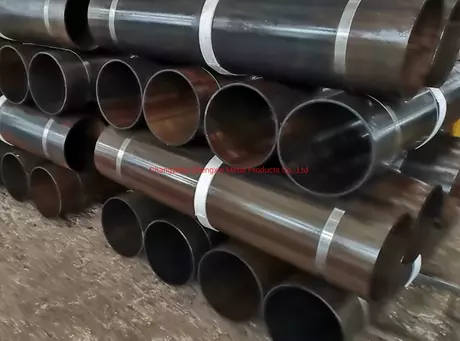
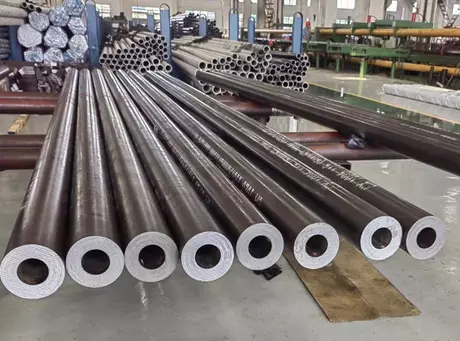
When engineers and procurement teams specify CDW tubes (cold drawn welded tubes), one question comes up more than almost any other: "What exactly is inside the steel, and does the chemistry match my application?" This guide answers that question from the ground up — no unnecessary jargon, just clear explanations of what each element does, how the grades compare, and how to choose the right one.
Key Takeaways
CDW tubes are cold drawn welded tubes made from ERW (Electric Resistance Welded) pre-tubes, drawn through a die and over a mandrel for precision dimensions.
The primary international standard for CDW tube chemical composition is EN 10305-2, covering grades E195, E235, E275, and E355.
Each grade differs mainly in carbon (C), silicon (Si), and manganese (Mn) content — the three elements that most directly control strength.
E235 suits moderate-load applications; E355 is the go-to for high-pressure or heavy-duty use.
Phosphorus (P) and sulfur (S) are both capped at ≤0.025% across all grades to maintain good weldability and ductility.
Chemical composition directly affects which delivery condition (+C, +N, +SR, etc.) is achievable and what mechanical strength the finished CDW tube will deliver.
What Are CDW Tubes? A Quick Primer
The term cold drawn welded tube (CDW tube) describes a manufacturing method, not just a product. The process begins with a steel strip that is roll-formed and electric-resistance welded into a round tube — the ERW stage. That welded tube is then drawn through a precision die and over a mandrel at room temperature. This cold drawing step eliminates the internal weld flash, tightens the dimensions, and work-hardens the steel, producing a tube with a near-seamless appearance and excellent surface quality.
In North America the same product is widely known as DOM tubing (Drawn Over Mandrel). In Europe and Asia the term CDW tube or cold drawn welded tube is standard. The underlying process is essentially the same; only the regional vocabulary differs. Learn more about the CDW process definition.
Because the cold drawing process fundamentally changes the steel's microstructure, the chemical composition of the starting material matters enormously. It determines how strong the tube can become, how well it tolerates further forming or welding, and how it behaves at elevated pressures.
Why Chemical Composition Matters for CDW Tubes
Steel is mostly iron, but the small percentages of other elements — carbon, manganese, silicon, phosphorus, and sulfur — control almost everything that matters in a structural tube:
Carbon (C) is the primary strengthening element. More carbon means higher tensile and yield strength but reduced ductility and weldability.
Manganese (Mn) increases toughness and hardenability. It also acts as a deoxidizer during steelmaking, helping to keep inclusions low.
Silicon (Si) further strengthens the steel and improves elasticity. Higher silicon content contributes to the superior mechanical properties seen in higher-grade CDW tubes.
Phosphorus (P) is a tramp element that must be kept low. Elevated phosphorus causes cold brittleness — the tube may crack at low temperatures or under impact loading.
Sulfur (S) improves machinability in free-cutting steels but causes hot shortness in most structural steels. It is tightly controlled in CDW tube grades.
Aluminum (Al) is used in some grades as a deoxidizer and grain refiner. A minimum aluminum level ensures a finer, more uniform grain structure.
The EN 10305-2 standard assigns specific limits to each of these elements for every CDW tube grade, so that buyers worldwide receive consistent, predictable material. See the full EN 10305-2 E235 specification sheet.
EN 10305-2: The Key Standard for CDW Tube Chemical Composition
EN 10305-2 is published by the European Committee for Standardization and covers steel tubes for precision applications — Part 2: Welded cold drawn tubes. It is the benchmark standard that most reputable CDW tube manufacturers worldwide align with, even for products sold outside Europe.
The standard defines five commercial grades of cold drawn welded tubes: E155, E195, E235, E275, and E355. The number after the "E" represents the minimum yield strength in megapascals (MPa) — so E355 has a minimum yield strength of 355 MPa in the normalized condition. This makes the grade designation a direct signal of load-bearing capacity.
Equivalent standards in other systems include DIN 2393 (Germany) and BS 6323-6 (United Kingdom). A cross-reference appears in the grade comparison table below.
CDW Tube Chemical Composition Table (EN 10305-2)
The table below shows the maximum allowable element percentages for each CDW tube grade under EN 10305-2. All values are maximum limits unless otherwise noted.
| Grade (Name) | Steel No. | C % (max) | Mn % (max) | Si % (max) | P % (max) | S % (max) | Al % (min) |
|---|---|---|---|---|---|---|---|
| E155 | 1.0033 | 0.11 | 0.70 | 0.35 | 0.025 | 0.025 | 0.015 |
| E195 | 1.0034 | 0.15 | 0.70 | 0.35 | 0.025 | 0.025 | 0.015 |
| E235 | 1.0308 | 0.17 | 1.20 | 0.35 | 0.025 | 0.025 | 0.015 |
| E275 | 1.0225 | 0.21 | 1.40 | 0.35 | 0.025 | 0.025 | 0.015 |
| E355 | 1.0580 | 0.22 | 1.60 | 0.55 | 0.025 | 0.025 | 0.020 |
Source: EN 10305-2 standard; Al minimum applies to fine-grain practice steels. CHENGXIN supplies E195, E235, E275, and E355.
A few things stand out from this table:
Carbon climbs steadily from E155 (0.11%) to E355 (0.22%), explaining why strength increases with each grade.
Manganese follows the same upward trend — E355's 1.60% Mn limit versus E195's 0.70% is a significant difference in toughening capacity.
E355 is also the only grade with a higher silicon ceiling (0.55% vs. 0.35%), which further boosts its strength and elasticity.
Phosphorus and sulfur are identically capped at 0.025% across the board — a deliberate choice by the standard to protect weldability in all grades.
Grade-by-Grade Breakdown: What the Chemistry Means in Practice
E195 — The Light-Duty Workhorse
With carbon capped at just 0.15% and manganese at 0.70%, E195 is the softest and most ductile of the mainstream CDW tube grades. It bends easily without cracking, which makes it popular for furniture frames, decorative tubing, and light structural components where formability matters more than raw strength. It is not well suited to high-pressure hydraulic or heavy mechanical applications.
E235 — The Versatile Mid-Range Grade
E235 is by far the most widely specified grade for general-purpose cold drawn welded tubes. Its carbon ceiling of 0.17% and manganese limit of 1.20% give it a balanced profile: enough strength for a broad range of mechanical and automotive uses, yet enough ductility for moderate forming, bending, and welding without special precautions. Typical applications include automotive steering columns, light hydraulic cylinder tubes, and mechanical bushings. View the EN 10305-2 E235 grade data sheet.
E275 — The Bridge Grade
E275 occupies a useful middle ground between E235 and E355. Carbon rises to 0.21% and manganese to 1.40%, delivering a meaningful strength uplift over E235 without the full cost premium of E355. It sees use in agricultural machinery components, mid-range hydraulic systems, and structural parts where a stronger-than-standard CDW tube is needed but the application does not demand the highest available grade.
E355 — The High-Performance Grade
E355 is the strongest standard grade under EN 10305-2 for CDW tubes. The combination of 0.22% carbon, 1.60% manganese, and 0.55% silicon produces a tube that can achieve a tensile strength of 490–630 MPa and a yield strength of 355 MPa in the normalized condition. This makes it the default choice for high-pressure hydraulic cylinders, heavy equipment frames, shock absorber tubes, and any application where the tube must withstand significant cyclic loading. View the EN 10305-2 E355 grade data sheet.
Mechanical Properties Linked to Chemical Composition
Chemical composition sets the ceiling on what is achievable; the delivery condition determines where within that ceiling the tube actually lands. EN 10305-2 recognizes five delivery conditions for CDW tubes:
| Symbol | Condition | Description |
|---|---|---|
| +C | Cold drawn (hard) | Maximum strength, minimum elongation. Tube left in its as-drawn state. |
| +LC | Cold drawn (soft) | Lower strength than +C, improved ductility. |
| +SR | Stress relieved | Drawn, then stress relieved by low-temperature heat treatment. Balances strength and toughness. |
| +A | Annealed | Fully annealed for maximum ductility and formability. |
| +N | Normalized | Heated above the transformation range and air-cooled. Most common for hydraulic applications. |
The table below shows the mechanical properties by grade and delivery condition under EN 10305-2:
| Grade | Condition | Tensile Strength Rm (MPa) | Yield Strength ReH (MPa min) | Elongation A (%) |
|---|---|---|---|---|
| E235 (1.0308) | +C | 480 min | — | 6 min |
| +LC | 420 min | — | 10 min | |
| +SR | 420 min | 350 | 16 min | |
| +A | 315 min | — | 25 min | |
| +N | 340–480 | 235 | 25 min | |
| E355 (1.0580) | +C | 640 min | — | 4 min |
| +LC | 590 min | — | 6 min | |
| +SR | 590 min | 435 | 10 min | |
| +A | 450 min | — | 22 min | |
| +N | 490–630 | 355 | 22 min |
Data per EN 10305-2. Values apply to CDW tubes with wall thickness ≤ 10 mm.
Notice how the higher carbon and manganese in E355 translate directly into a 51% higher yield strength (355 vs. 235 MPa in +N condition) compared to E235. That gap is entirely driven by the chemistry difference shown in the composition table above.
How to Choose the Right CDW Tube Grade for Your Application
Grade Selection Quick Guide
| Application Type | Recommended Grade | Typical Delivery Condition |
|---|---|---|
| Furniture, light structural frames | E195 | +A or +N |
| Automotive steering columns, bushings | E235 | +N or +SR |
| Agricultural machinery components | E275 or E235 | +N |
| Light hydraulic cylinders | E235 | +N or +SR |
| Heavy hydraulic cylinders, excavators | E355 | +N or +SR |
| Shock absorbers, high-pressure systems | E355 | +C or +SR |
| Precision mechanical shafts & sleeves | E235 or E355 | +C |
Three practical questions guide grade selection for cold drawn welded tubes:
What pressure or load will the tube carry? Higher loads point to E355; moderate loads are well served by E235.
Will the tube need further forming, bending, or welding after delivery? If yes, lower carbon (E195 or E235) and a softer delivery condition (+A or +N) reduce the risk of cracking or weld defects.
What is the operating temperature range? All EN 10305-2 grades are designed for ambient temperatures. For extreme cold environments, a grade with minimum aluminum (fine-grain practice) improves impact toughness.
International Equivalent Standards for CDW Tubes
Procurement teams often need to match an EN 10305-2 grade to a legacy specification in another standard. The table below provides the most common equivalents for the two principal CDW tube grades.
| EN 10305-2 | DIN 2393 (Germany) | BS 6323-6 (UK) | NF A49-341 (France) |
|---|---|---|---|
| E195 | RSt34-2 | CEW 2 | TS-30a |
| E235 | RSt37-2 | CEW 4 | TS-34a |
| E275 | St44-2 | CEW 4 | TS-42a |
| E355 | St52-3 | CEW 5 | TS-47a |
Equivalences are approximate. Always verify with the material test certificate before substituting grades in a critical application.
What Each Chemical Element Actually Does Inside a CDW Tube
Carbon — The Primary Strength Controller
Carbon atoms lock into the iron lattice and restrict the movement of dislocations — the microscopic defects that allow metals to deform. More carbon means more resistance to deformation, which translates to higher yield and tensile strength. The trade-off is reduced ductility: a high-carbon tube bends less before cracking and is harder to weld without preheating. EN 10305-2 keeps maximum carbon below 0.22% even in E355 to preserve adequate weldability and ductility across all CDW tube grades.
Manganese — Toughness and Hardenability
Manganese strengthens steel by solid-solution hardening and by combining with sulfur to form manganese sulfide (MnS) inclusions, which are far less harmful than iron sulfide. It also increases hardenability — the depth to which the steel can be hardened by heat treatment. In cold drawn welded tubes, the higher manganese levels in E275 and E355 directly support their ability to reach higher strength levels through the cold drawing process and subsequent heat treatment.
Silicon — Elasticity and Deoxidation
Silicon acts as a deoxidizer during steelmaking, removing oxygen that would otherwise form harmful pores or inclusions. It also raises the elastic limit of the steel, which is why E355 — the grade that benefits most from high elasticity — has the highest silicon ceiling (0.55%) of any CDW tube grade under EN 10305-2.
Phosphorus and Sulfur — Controlled Impurities
Both phosphorus and sulfur are unavoidable impurities from raw materials and the steelmaking process. Phosphorus causes grain boundary embrittlement, particularly at low temperatures. Sulfur causes hot shortness — cracking during high-temperature processing. EN 10305-2 caps both at 0.025% maximum across all CDW tube grades precisely because keeping them low is non-negotiable for reliable structural tubing.
Aluminum — Grain Refinement
Aluminum is added in small amounts (≥0.015–0.020%) to deoxidize the melt and pin grain boundaries during heat treatment. Finer grains produce a tougher, more impact-resistant steel. This is particularly important for CDW tubes destined for normalized (+N) delivery and use in cold-climate environments.
How Chemical Composition Is Verified: Testing and Certification
Knowing the specified chemistry is important, but verifying the actual chemistry of a delivered batch is equally critical. Reputable CDW tube manufacturers follow EN 10305-2's mandatory inspection protocol, which includes:
Heat analysis (ladle analysis): A sample is taken from the molten steel at the time of casting. This is the primary record of chemical composition and forms the basis of the mill test certificate.
Product analysis: Additional samples taken from finished tubes confirm that the heat analysis chemistry is reflected in the final product, accounting for any segregation or variation during casting and rolling.
Optical emission spectrometry (OES) or X-ray fluorescence (XRF): These instruments measure element percentages quickly and precisely on the shop floor or in a quality laboratory.
EN 10204 3.1 Mill Test Certificate: This is the formal document that records the chemical and mechanical test results for a specific batch. It is signed by the manufacturer's inspection representative and should accompany every delivery of structural CDW tubes.
When sourcing cold drawn welded tubes for any structural or pressure application, always request and review the 3.1 Mill Test Certificate. It should list the heat number, chemical composition per element, and mechanical test results, all traceable to the specific tube batch shipped.
CDW Tube vs. Seamless Tube: Does Chemical Composition Differ?
A common question is whether the chemical composition of a cold drawn welded tube differs from that of a cold drawn seamless tube. The answer is generally no — both product types can be produced in the same steel grades (E235, E355, etc.), and the chemical composition limits defined in EN 10305-2 (CDW) and EN 10305-1 (seamless) are nearly identical for equivalent grades.
The real difference lies in the manufacturing process and resulting properties: CDW tubes start as welded pre-tubes and benefit from the weld-flash removal and dimensional refinement of cold drawing. Seamless tubes start from a solid billet and are pierced and drawn without any weld. For most applications, both types with the same grade and delivery condition will have comparable mechanical properties. For extreme pressure or highly critical safety applications, seamless tubes may be preferred because they have no weld zone at all — but for the vast majority of hydraulic, automotive, and mechanical uses, CDW tubes in E235 or E355 deliver fully equivalent performance at a better cost point.
Summary: CDW Tube Chemical Composition at a Glance
The chemical composition of a CDW tube is not just a line on a certificate — it is the fundamental factor that determines the tube's strength, ductility, weldability, and suitability for any given application. Under EN 10305-2, five grades (E155 through E355) are defined, each with progressively higher carbon, manganese, and — for E355 — silicon content. These chemistry differences produce measurable, predictable differences in yield strength, tensile strength, and elongation across all delivery conditions.
For most industrial and automotive applications, E235 offers an excellent balance of strength and formability. For heavy-duty and high-pressure demands, E355 is the right choice. And in all cases, a valid EN 10204 3.1 Mill Test Certificate from a traceable manufacturer is the non-negotiable document that confirms the actual chemistry of the tubes received.
If the goal is sourcing CDW tubes from a manufacturer with strict chemical composition control and full documentation, CHENGXIN is a trusted partner for precision cold drawn welded tubes that meet EN 10305-2 requirements.
Frequently Asked Questions (FAQ)
Under EN 10305-2, E355 (steel number 1.0580) has maximum limits of C ≤ 0.22%, Mn ≤ 1.60%, Si ≤ 0.55%, P ≤ 0.025%, S ≤ 0.025%, and Al ≥ 0.020% (for fine-grain practice). These limits give E355 its superior strength compared to lower grades.
It depends on the operating pressure. E235 works well for light to medium hydraulic cylinders (typically up to around 150–200 bar depending on wall thickness and bore). E355 is preferred for heavier-duty systems and higher pressures, thanks to its higher yield strength (355 MPa vs. 235 MPa in +N condition).
Yes. All EN 10305-2 grades are designed with phosphorus and sulfur controlled at ≤ 0.025%, which supports good weldability. E195 and E235 are the easiest to weld without preheating. E355 may require preheating for thicker walls to avoid cracking in the heat-affected zone.
These are delivery condition codes. "+N" means normalized — heated above the grain transformation temperature and air-cooled, giving a balanced combination of strength and ductility. "+SR" means stress relieved — drawn and then gently heat-treated to reduce internal stresses without significantly changing the microstructure. "+C" means cold drawn (hard), delivering maximum strength.
There is no chemistry difference between CDW and DOM tubing — they describe the same cold-drawing-over-mandrel process. "CDW" is the common term in Europe and Asia (typically referencing EN 10305-2 grades E195–E355), while "DOM" is the common term in North America (often referencing SAE 1020 or 1026 carbon steel grades under ASTM standards). Both types can be produced in equivalent steel chemistries.
Request an EN 10204 3.1 Mill Test Certificate with every order. It documents the heat analysis and product analysis results, signed by the manufacturer's inspection authority. For critical applications, independent third-party testing (OES or XRF spectroscopy) on received samples provides additional assurance.
Yes. CHENGXIN provides EN 10204 3.1 Mill Test Certificates for all cold drawn welded tubes, covering chemical composition, mechanical properties, and dimensional inspection results. Custom documentation is available on request.